;%20stroke:%20rgb(0,%200,%200);'%20points='285.27%20368.275%20283.496%2084.371%20214.726%2044.317%20214.66%20327.502'/%3e%3cpolyline%20style='fill:%20rgb(216,%20216,%20216);%20stroke:%20rgb(0,%200,%200);'%20points='397.639%2068.734%20395.491%20192.886%20310.683%20193.101%20311.951%20263.647%20393.638%20263.389%20396.525%20399.116%20468.544%20360.042%20470.622%20112.935%20394.992%2068.782'/%3e%3cbx:export%3e%3cbx:file%20format='svg'%20path='Sans%20titre.svg'/%3e%3c/bx:export%3e%3c/defs%3e%3cpolygon%20style='stroke:%20rgb(42,%20114,%20150);%20fill:%20rgb(42,%20115,%20150);'%20points='23.05%20112.669%2095.202%2069.641%2095.097%20322.785%20158.327%20359.414%20158.234%20445.237%2022.607%20362.225'/%3e%3cpolygon%20style='fill:%20rgb(28,%2050,%2073);%20stroke:%20rgb(28,%2050,%2073);'%20points='309.844%20263.069%20309.921%20191.958%20396.048%20192.8%20395.252%2067.002%20469.494%20113.146%20469.821%20361.782%20394.692%20405.389%20394.653%20263.025'/%3e%3cpolygon%20style='fill:%20rgb(28,%2050,%2073);%20paint-order:%20fill;%20stroke:%20rgb(28,%2050,%2073);'%20points='158.107%20359.308%20212.77%20327.456%20213.766%2043.376%20284.718%2084.199%20285.387%20367.637%20158.177%20445.353'/%3e%3c/svg%3e)
UrbaHive — Collaborative IT Mapping for SMEs and Mid-Market
Visualize, map, and manage your entire IT infrastructure with your team. Bring clarity to complexity.

Why useUrbaHive?
Discover how UrbaHive solves real challenges for IT teams every day.
Accelerate your IT project scoping
Every new project starts with weeks spent identifying affected applications, dependencies, and stakeholders. Scoping takes longer than the project itself.
With impact analysis, see the affected applications, their direct dependencies and the people responsible. Export the application-flow diagram as PNG or PDF for the steering committee.
Scoping that takes weeks can come down to a few days — projects start from a shared baseline.
Drive your cloud migration with zero blind spots
You want to move to the cloud, but you can't tell which applications are eligible, which have critical dependencies, and in what order to proceed.
Map your existing IT, qualify each application (status, hosting, vendor, technical stack) and prepare your migration waves with a clear view of direct dependencies.
A migration plan prepared in a few weeks rather than several months, with fewer forgotten dependencies.
Onboard your devs faster
Every new developer spends 2-3 weeks understanding the technical ecosystem: which services exist, who maintains them, how they communicate.
Give every new hire a shared map of your tech stack. Applications, their flows and the people responsible are visible at a glance.
A technical onboarding of several weeks can come down to a few days — devs contribute sooner.
Rooted in urbanization best practices,built for everyone
Built on 25 years of best practices
UrbaHive is built on the proven foundations of IT urbanization: business, functional, application, and technical layers. The repository imports and exports in the ArchiMate exchange format (XML), so it travels to and from Archi and other tools that read that format.
But designed for every team
Unlike traditional EA tools reserved for architects, UrbaHive is designed for everyone who works with IT systems daily. The intuitive interface lets every role contribute, explore, and collaborate — without weeks of training.
order of magnitude to get up and running
typical target for a usable first map
Not months. Weeks.
Getting started takes hours, not multi-day training sessions. A usable first map is a target of a few weeks, not months — orders of magnitude, which depend on the size of your IT landscape.
Built for
Free plan — 1 user, 25 applications, no credit card required
Everything you need to map yourIT infrastructure
Powerful features designed for modern IT teams who need clarity and collaboration.
Visual Infrastructure Mapping
Application-flow and infrastructure diagrams generated from your repository, exportable as PNG and PDF.
Collaborative workspace for teams
Invite colleagues by email, give each one of four roles, from owner to viewer, and find every change in the audit log.
Modern Tools for IT teams
We strongly believe that IT teams should have access to modern tools to manage their infrastructure.
Enterprise Security
Data hosted in the European Union, encrypted in transit and at rest, roles per organisation and an audit log of every change.
Import / Export
Import and export your architecture models using the ArchiMate Exchange Format, the open standard from The Open Group for Enterprise Architecture tool interoperability.
Several organisations, one account
Create a separate organisation per entity or client and switch between them with the same account. Each infrastructure carries a location field.
Your business processes,wired into your map
Document your processes, link every step to your applications and teams, then let UrbaHive reveal where to automate and where the risks hide.
Linked to your IT
Each step is tied to its actors and the applications that support it. Business processes and application mapping become one.
Optimization score
A volume-weighted score surfaces the processes with the highest automation potential, so you prioritize without debate.
Automatable hours
UrbaHive quantifies the hours you can reclaim every month from the duration and mode of each step (manual, assisted, automated).
Operational risks
Single points of knowledge (bus-factor), processes without an owner or not reviewed in 12 months: blind spots surface automatically.
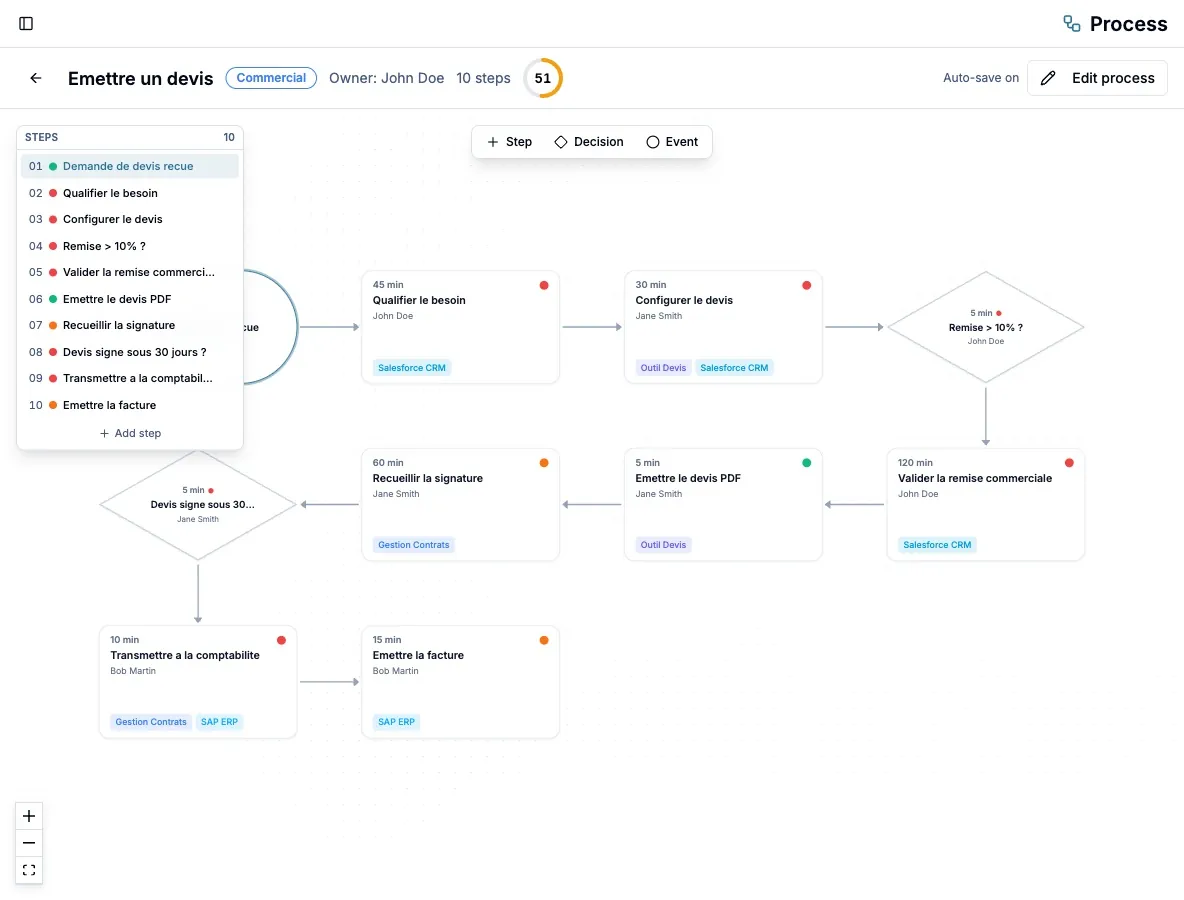
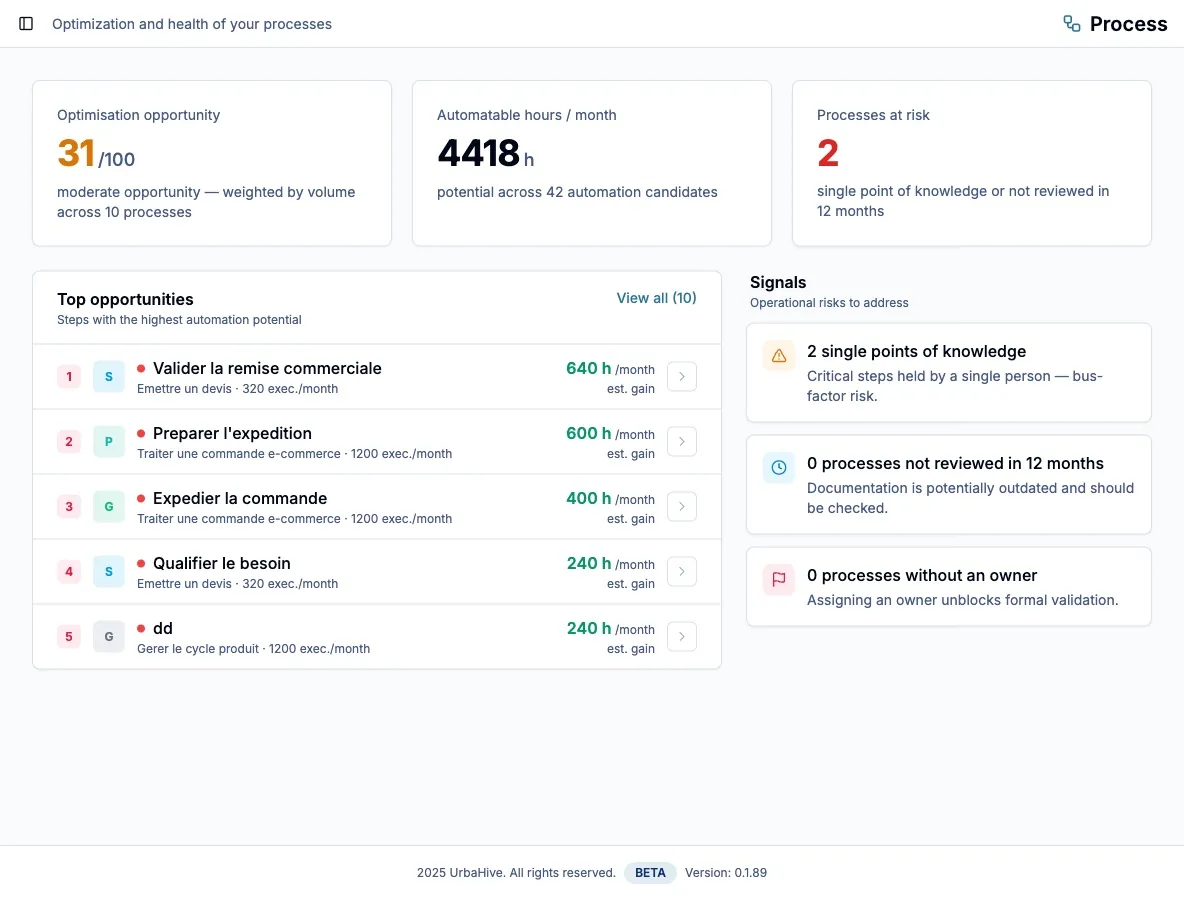
From documentation to decision
The dashboard rolls your processes up into actionable metrics: overall optimization opportunity, automatable hours per month, and the top high-gain steps. Operational signals flag risks before they get expensive.
Optimization score
Automatable hours
Processes at risk
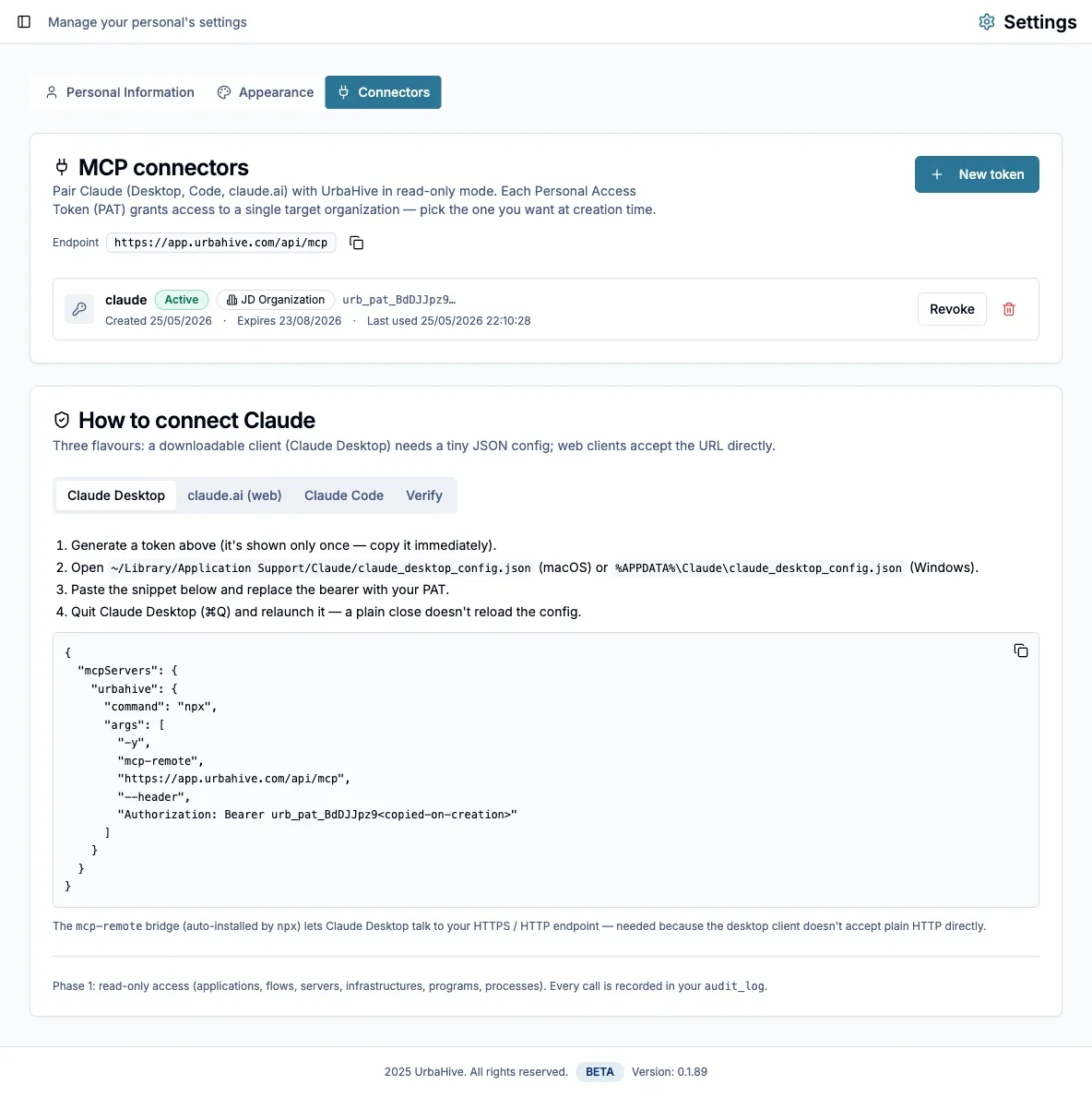
Connect Claudeto your architecture
With the MCP (Model Context Protocol) standard, your UrbaHive map becomes a context source for AI assistants. Generate a token, plug in Claude, Cursor, Codex, Windsurf or Devin — query your IT landscape, and even let an agent bootstrap it from your code.
Works with
Query your IT in plain language
Ask Claude your questions — applications, flows, servers, programs, processes — and get answers pulled straight from your map.
Read or write — your choice
Each access token (PAT) targets a single organization. Read-only by default; enable write on demand ('write' scope + role) so an agent can create or update your map. 70 tools: 31 read, 39 write, no delete tool.
Fully audited
Every call is recorded in your audit log. UrbaHive stores your data in the European Union; what you send to your AI assistant, however, is handled by that assistant's provider.
For example, ask Claude:
- “Which applications depend on the SAP server?”
- “Summarize my IT landscape in five points.”
- “Which business processes run through Salesforce?”
Simple, transparentpricing
Choose the plan that fits your team's needs
Free
Perfect for individual developers
- 1 user
- All features included
- Up to 25 applications
- Community support
Starter
Perfect for small teams getting started
- Up to 5 team members
- All features included
- Roles, invitations and audit log
- Email support
- Up to 100 applications
Professional
For growing teams with advanced needs
- Up to 25 team members
- All features included
- Email support
- Up to 200 applications
- Payment by purchase order or bank transfer
Enterprise
For large organizations
- Custom number of users
- All features included
- Dedicated support
- Custom number of applications
- Payment by purchase order or bank transfer
- SLA guarantee
- On-premise option (Kubernetes / Docker)
Security you cantrust
Your infrastructure data is sensitive: it is hosted in the European Union and encrypted in transit and at rest.
Hosted in the European Union
Your data is stored in the EU, encrypted in transit (TLS) and at rest. Backups are encrypted, kept 30 days, and their restore is tested every month.
Role-Based Access Control
Four roles per organisation (Owner, Editor, Member, Viewer), assigned to each person you invite.
Detailed audit log
Every creation, change and deletion is recorded with before / after values, as is every AI connector call. Browsable in the app, with filters.
Data Privacy
Your data stays yours: you can delete your organisation and your account from the app.
AboutUrbaHive
UrbaHive was born from a simple observation: IT teams spend countless hours creating and updating infrastructure diagrams that quickly become outdated. We knew there had to be a better way.
Our Mission
To simplify Enterprise Architecture management through collaborative visualization, making complex systems understandable for every team member.
Innovation First
We continuously push boundaries to deliver cutting-edge tools that transform how teams keep their application portfolio up to date.
Built for Teams
Collaboration is at our core. Because we know that a single person, a team can maintain and keep an IT landscape up to date.
Our Story
Founded in 2025 by a team of architects and engineers, UrbaHive emerged from real-world frustrations with expensive existing tools use to describe the urbanisation of IT infrastructure.
Today, we're proud to deliver a full efficient and modern platform for Enterprise Architects, helping you visualize and manage your IT mapping with unprecedented clarity and collaboration.
Join us in revolutionizing how teams understand and manage their IT landscape.
Articles & resources
The most-read guides, comparisons, and methodologies on IS mapping, urbanization, NIS2, and DORA.
IS mapping: the complete guide
Definition, 5-step methodology, frameworks, benefits, and pitfalls to avoid.
Read article →2026 EA tools comparison: LeanIX, Ardoq, UrbaHive
Honest comparison table of leading solutions, pricing, NIS2, hosting.
Read article →NIS2 for SMEs: 2026 compliance
17/10/2026 deadline, sanctions, 10-step action plan.
Read article →DORA: financial sector IS mapping
Third-party registry, IT dependencies, ACPR/AMF requirements.
Read article →IS urbanization: the complete guide
Principles, approach, governance, from legacy to cloud-native.
Read article →IS master plan: methodology + template
Build an actionable master plan in 7 steps.
Read article →IS mapping for CISOs
Asset classification, third-party suppliers, NIS2, audit.
Read article →ArchiMate: understanding the EA language
Layers, elements, views, and how to use it painlessly.
Read article →UrbaHive vs LeanIX: honest comparison
Pricing, features, EU hosting, NIS2, ergonomics.
Read article →
White paper · Competitive landscape
Mapping your IT in 2026: where does UrbaHive fit?
12 solutions analyzed — LeanIX, Ardoq, Bizzdesign/MEGA, Sparx, myCarto, Carto-SI… Strengths, limits, pricing, NIS2/DORA compliance, and a decision grid. Free access, no form.
Frequently asked questions
What is information system (IS) mapping?
IS mapping is the structured visual representation of every component of an information system: applications, data, flows, infrastructure, business processes, and stakeholders. It lets CIOs, architects, and project leads understand, govern, and evolve their IS without blind spots. UrbaHive keeps this map in a shared repository that the whole team maintains, and generates the diagrams from that repository.
Who is UrbaHive for?
UrbaHive is built for French and European SMEs and mid-market companies (50 to 5,000 employees). Target users are CIOs, enterprise architects, CISOs, IT project leads, and CTOs. It is a lighter alternative to traditional enterprise tools (LeanIX, Ardoq, Mega Hopex), which are often too heavy and too expensive for mid-sized organizations.
How much does UrbaHive cost?
Four plans: Free (€0, 1 user, 25 applications, no credit card, no time limit), Starter (€29/month, 5 users, 100 applications), Professional (€99/month, 25 users, 200 applications), and Enterprise (on quote, custom quotas, on-premise option, SLA and dedicated support). Monthly plans can be cancelled at any time; payment by card, and by purchase order or bank transfer on the Professional and Enterprise plans.
How does UrbaHive compare to LeanIX or Ardoq?
LeanIX (SAP) and Ardoq are powerful enterprise tools designed for large organizations (€50k–100k/year, 6–12 month rollouts). UrbaHive targets SMEs and mid-market with a different approach: get started in a few hours, accessible pricing (from €0), hosting in the European Union (Vercel and Supabase), a collaborative multi-user repository and an AI connector (MCP).
Does UrbaHive help prepare for NIS2 and DORA?
UrbaHive is not a compliance tool, but it provides the groundwork these texts presuppose. NIS2 (Article 21) and DORA require knowing your assets, their dependencies and who is responsible for them. UrbaHive's repository (applications, servers, flows, vendors, internal or external services, owners), its impact analysis and its audit log provide that inventory and traceability, kept up to date as a team and hosted in the European Union.
Is my data hosted in Europe?
Yes. UrbaHive is hosted on Vercel and Supabase, in European Union regions only: customer data is stored in the EU. It is encrypted in transit and at rest, and backups are encrypted and retained 30 days. The four roles per organization (Owner, Editor, Member, Viewer) and the audit log are included in every plan, including the free plan.